 | ||
Marie Eble, Jean Newman, Hugh Milburn, Frank González, Eddie Bernard, Goal
Acquire high-quality tsunami field measurements to improve numerical models and increase the speed and accuracy of tsunami warnings. | ||
 |
| ||
Marie Eble, Jean Newman, Hugh Milburn, Frank González, Eddie Bernard, Goal
Acquire high-quality tsunami field measurements to improve numerical models and increase the speed and accuracy of tsunami warnings. | ||
|
Accomplishments | ||
Deep-ocean Assessment and Reporting of Tsunamis (DART) | ||
 |
 DART real-time system BPR data are transmitted by acoustic modem | |
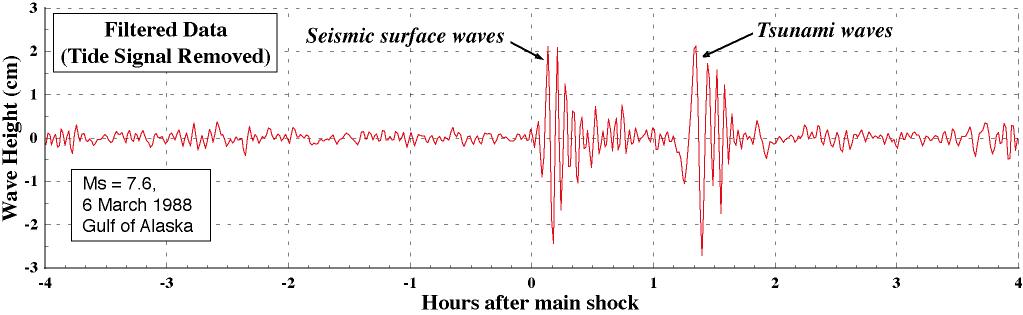
Bottom pressure recorders (BPRs)
developed by the Engineering Development Division and the Tsunami Project have been used for over a decade to measure and record tsunami amplitudes of less than 1 cm in the deep ocean. This BPR technology has been incorporated into the DART reporting system developed as part of the U.S. National Tsunami Hazard Mitigation Program. |  |
|
Inundation Field Surveys The Tsunami Project has participated in several post-tsunami field surveys, such as that
conducted after the 12 July 1993 Okushiri Island event. Ground surveys are frequently limited by post-disaster conditions, and biased toward high runup values. Aerial stereophotography, when available, can provide a more complete range of maximum vertical and horizontal tsunami runup estimates on a regional scale. | Pacific-wide Monitoring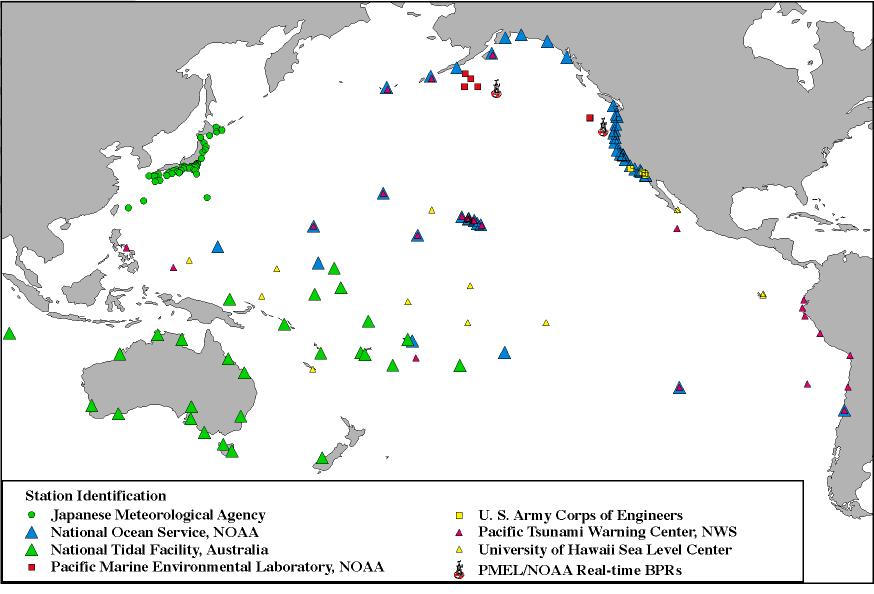 Six deep-ocean BPR stations are maintained by the Tsunami Project and more than 150 coastal stations are currently maintained by NOS and other Pacific nations. Several Pacific-wide tsunami datasets have been collected. The 1996 Andreanov data are available on the World Wide Web. | |
| ||
 |
Future Directions
• Design next generation of real-time systems to reduce data losses and improve reliability.
• Establish a six-station Early Tsunami Detection and Real-Time Reporting Network.
• Continue rapid data collection in response to future tsunami events. Partial funding for this research was provided by NOAA/OAR and DOD/DARPA
PMEL 1998 Program Review - http://www.pmel.noaa.gov/programs/98prog-agenda.html
|
 |